
On September 17, 1990, the Los Angeles Times printed an article about American Assets Trust’s acquisition of the Loma Palisades apartment complex that July. Although American Assets Trust was owned by famed philanthropist Ernest Rady, the company immediately increased the rent 10%, told 70 of the residents they would have to move out, and began disruptive construction projects—ripping the roof off of a resident’s apartment while they were still in it, for example. A month later on August 28, 1990, a tenant and 62-year-old grandfather named Lester Finkelstein committed suicide by drowning himself in the pool because he feared homelessness. His roommate, Scott Rohter, began a rent strike to protest the rent increases. When asked for comment on these events, an American Assets Trust official stated that “change is difficult” but that it would be “worth it” because American Assets Trust was making sure the property would no longer be an “eyesore.”
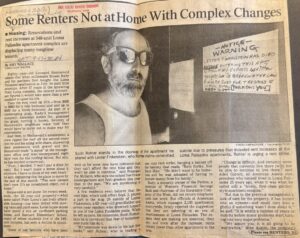
An image of the Loma Palisades LA Times Article written by Amy Wallace, featuring a photograph by Vince Compagnone
Apparently, neatly trimmed hedges and trees are worth tenants’ lives.
Thirty-six years later, Ernest Rady touts millions of dollars in donations to homelessness services at Salvation Army and his name is on one of their facilities, Rady Center. No one questions how his own business pushes tenants onto the street. American Assets Trust net an income of $72.82 million in 2024, even after paying Rady executive compensation of over $600,000.00 and $2,490,000 in bonuses that year. American Assets Trust openly brags about using the same strategies that ended in tragedy for the residents of Point Loma in 1990 on their recent acquisitions.
On February 28, 2025, American Assets Trust acquired Genesee Park and gleefully announced to all of its investors that it would be “optimizing rental rates” to “unlock the property’s full value.” Residents who have lived at Genesee Park for decades with their families complained about the rent increases. However, management told them that American Assets Trust was entitled to demand the maximum rent increase every year. Now elder, disabled, and low-income residents fear they will meet the same fate as the residents of Loma Palisades.
This is the renoviction game, and it is destroying our communities.
The renoviction game is described beautifully by Cole Webber and Philip Zigman in their book: Renoviction and Resistance in the Capitalist City. They use case studies from across Canada to demonstrate that renoviction is a strategy to permanently displace tenants from rental units to increase rent revenue. Repairs and renovations are only an excuse for this displacement; whether or not the renovations are completed is beside the point.
The game works like this:
- Businesses like Ernest Rady’s American Assets Trust identify a rent gap at an apartment complex. This means that the rents actually paid are less than the maximum amount the business could squeeze out of tenants in the local rental market. (Sometimes developers say the rents actually paid at the complex are less than “market rate” or “market price.” We won’t use the term “market rate” because this implies that the units in the complex have some objective value developers are entitled to. What developers are really looking at is how much they can get away with exploiting tenants for.)
- The business then buys the complex while the lower rents are being paid. If they can find a way to get the maximum rent out of the complex, they and their investors will make a ton of money.
- In California, the primary obstacle to maximizing rent is the tenants currently living there, who are protected by rent control limits of 10% or lower per year.
- Existing tenants protected by rent control can be removed by (1) systematically pricing those tenants out by increasing rent as much as possible and adding on new fees such as parking; (2) harassing the tenants out by ignoring repair requests, conducting multiple inspections to invade their privacy and peace of mind, or conducting construction in the most disruptive way possible; (3) threatening tenants with eviction so they self-evict; and/or (4) getting permits from the city to sanction kicking tenants out based on the legal excuse of “necessary repairs.”
Residents at Genesee Park have endured systematic maximum rent increases, disruptive construction, inspections without adequate notice, and refusal to update or repair the interior of units occupied by existing tenants protected by rent control unless they give up their rent control and sign a new lease. Tenants who have approached attorneys have been told that the rent increases and refusal to update units are legal.
Better knowledge of the law and legal representation cannot help tenants when they confront most renoviction strategies. In fact, the whole strategy of using renovations as an excuse to push tenants out has been enshrined in the Tenant Protection Act and San Diego’s Residential Tenant Protection Ordinance as a legitimate kind of “no-fault eviction.” California’s rent control law has established the exact amount a landlord can squeeze people and get away with it.
The fact that renoviction is legal does not, of course, make what developers like Ernest Rady and American Asset Trust are choosing to do right. There is no world in which Ernest Rady needs a bonus of $2.5 million a year instead of letting a respected elder on disability stay in their community at their existing rental rate. There is no world in which it is fair that he then gets to spread his legacy as “San Diego Person of the Year” or “Philanthropist of the Year” with his name on a building addressing the very problems he created. And that is why tenants choose to fight back when no one else will.

Image of a sign in a tenant’s windshield urging prospective tenants looking at Genesee Park apartments not to rent there until the landlord stops the rent hikes.
At Geneseee Park, conditions during construction did not improve until tenants began organizing. Management did not even discuss rent abatements or rent freezes until tenants sent a demand letter signed by a quarter of units at the 199-unit complex and started showing out in force at meetings by the complex’s pool.
The members of Genesee Park Tenants Council aren’t playing the renoviction game. Neither should we. Every time we surrender to a new rent increase or move to make way for new tenants, we’re perpetuating a cycle of displacement. The game will only end when we stop playing.
